#include <stdio.h>//printf とかで必要
#include<windows.h>//MessageBox とかで必要

void main(void)
{
 printf("コンソール表示開始\n");
 MessageBox(0,0,TEXT("OK"),0);
}

#include <stdio.h>//printf とかで必要
#include<windows.h>//MessageBox とかで必要
void main(void)
{
printf("コンソール表示開始\n");
MessageBox(0,0,TEXT("OK"),0);
}
  hMCI = MCIWndCreate(hWnd, ((LPCREATESTRUCT)lParam)->hInstance, 0, "G:\\sampleMovie\\AVI-352x240.AVI");
  MCIWndSetVolume(hMCI,0);//MCI ウィンドウの音量を設定0-1000
  MCIWndPlay(hMCI);//再生開始
#include <windows.h>
#include <stdlib.h>
#include <string.h>
#include <tchar.h>

#include <vfw.h>
#pragma comment (lib, "vfw32.lib")
// Global variables

// The main window class name.
static TCHAR szWindowClass[] = _T("win32app");

// The string that appears in the application's title bar.
static TCHAR szTitle[] = _T("Win32 Guided Tour Application");

HINSTANCE hInst;

// Forward declarations of functions included in this code module:
LRESULT CALLBACK WndProc(HWND, UINT, WPARAM, LPARAM);

int WINAPI WinMain(HINSTANCE hInstance,
                   HINSTANCE hPrevInstance,
                   LPSTR lpCmdLine,
                   int nCmdShow)
{
    WNDCLASSEX wcex;

    wcex.cbSize = sizeof(WNDCLASSEX);
    wcex.style          = CS_HREDRAW | CS_VREDRAW;
    wcex.lpfnWndProc    = WndProc;
    wcex.cbClsExtra     = 0;
    wcex.cbWndExtra     = 0;
    wcex.hInstance      = hInstance;
    wcex.hIcon          = LoadIcon(hInstance, MAKEINTRESOURCE(IDI_APPLICATION));
    wcex.hCursor        = LoadCursor(NULL, IDC_ARROW);
    wcex.hbrBackground  = (HBRUSH)(COLOR_WINDOW+1);
    wcex.lpszMenuName   = NULL;
    wcex.lpszClassName  = szWindowClass;
    wcex.hIconSm        = LoadIcon(wcex.hInstance, MAKEINTRESOURCE(IDI_APPLICATION));

    if (!RegisterClassEx(&wcex))
    {
        MessageBox(NULL,
            _T("Call to RegisterClassEx failed!"),
            _T("Win32 Guided Tour"),
            NULL);

        return 1;
    }

    hInst = hInstance; // Store instance handle in our global variable

    HWND hWnd = CreateWindow(
        szWindowClass,
        szTitle,
        WS_OVERLAPPEDWINDOW,
        CW_USEDEFAULT, CW_USEDEFAULT,
        500, 100,
        NULL,
        NULL,
        hInstance,
        NULL
    );

    if (!hWnd)
    {
        MessageBox(NULL,
            _T("Call to CreateWindow failed!"),
            _T("Win32 Guided Tour"),
            NULL);

        return 1;
    }

    ShowWindow(hWnd,
        nCmdShow);
    UpdateWindow(hWnd);

    // Main message loop:
    MSG msg;
    while (GetMessage(&msg, NULL, 0, 0))
    {
        TranslateMessage(&msg);
        DispatchMessage(&msg);
    }

    return (int) msg.wParam;
}

//
//  FUNCTION: WndProc(HWND, UINT, WPARAM, LPARAM)
//
//  PURPOSE:  Processes messages for the main window.
//
//  WM_PAINT    - Paint the main window
//  WM_DESTROY  - post a quit message and return
//
//
LRESULT CALLBACK WndProc(HWND hWnd, UINT message, WPARAM wParam, LPARAM lParam)
{
    TCHAR greeting[] = _T("MCI コマンド");

 //MCI関係
 static HWND hMCI;
 switch (message)
 {
 case WM_CREATE:
  hMCI = MCIWndCreate(hWnd, ((LPCREATESTRUCT)lParam)->hInstance, 0, "G:\\sampleMovie\\AVI-352x240.avi");
  MCIWndSeek(hMCI,145);//フレームで指定
  MCIWndPlay(hMCI);//再生開始

  break;
    case WM_DESTROY:
        PostQuitMessage(0);
        break;
    default:
        return DefWindowProc(hWnd, message, wParam, lParam);
        break;
    }

    return 0;
}
  hMCI = MCIWndCreate(hWnd, ((LPCREATESTRUCT)lParam)->hInstance, 0, "G:\\sampleMovie\\AVI-352x240.avi");
  MCIWndSetTimeFormat(hMCI,"ms");//MCIウインドウのタイムフォーマットをミリ秒に設定
  MCIWndSeek(hMCI,5000);//ミリ秒で指定
  MCIWndPlay(hMCI);//再生開始
#include <windows.h>
#include <stdlib.h>
#include <string.h>
#include <tchar.h>

#include <vfw.h>
#pragma comment (lib, "vfw32.lib")
// Global variables

// The main window class name.
static TCHAR szWindowClass[] = _T("win32app");

// The string that appears in the application's title bar.
static TCHAR szTitle[] = _T("Win32 Guided Tour Application");

HINSTANCE hInst;

// Forward declarations of functions included in this code module:
LRESULT CALLBACK WndProc(HWND, UINT, WPARAM, LPARAM);

int WINAPI WinMain(HINSTANCE hInstance,
                   HINSTANCE hPrevInstance,
                   LPSTR lpCmdLine,
                   int nCmdShow)
{
    WNDCLASSEX wcex;

    wcex.cbSize = sizeof(WNDCLASSEX);
    wcex.style          = CS_HREDRAW | CS_VREDRAW;
    wcex.lpfnWndProc    = WndProc;
    wcex.cbClsExtra     = 0;
    wcex.cbWndExtra     = 0;
    wcex.hInstance      = hInstance;
    wcex.hIcon          = LoadIcon(hInstance, MAKEINTRESOURCE(IDI_APPLICATION));
    wcex.hCursor        = LoadCursor(NULL, IDC_ARROW);
    wcex.hbrBackground  = (HBRUSH)(COLOR_WINDOW+1);
    wcex.lpszMenuName   = NULL;
    wcex.lpszClassName  = szWindowClass;
    wcex.hIconSm        = LoadIcon(wcex.hInstance, MAKEINTRESOURCE(IDI_APPLICATION));

    if (!RegisterClassEx(&wcex))
    {
        MessageBox(NULL,
            _T("Call to RegisterClassEx failed!"),
            _T("Win32 Guided Tour"),
            NULL);

        return 1;
    }

    hInst = hInstance; // Store instance handle in our global variable

    HWND hWnd = CreateWindow(
        szWindowClass,
        szTitle,
        WS_OVERLAPPEDWINDOW,
        CW_USEDEFAULT, CW_USEDEFAULT,
        500, 100,
        NULL,
        NULL,
        hInstance,
        NULL
    );

    if (!hWnd)
    {
        MessageBox(NULL,
            _T("Call to CreateWindow failed!"),
            _T("Win32 Guided Tour"),
            NULL);

        return 1;
    }

    ShowWindow(hWnd,
        nCmdShow);
    UpdateWindow(hWnd);

    // Main message loop:
    MSG msg;
    while (GetMessage(&msg, NULL, 0, 0))
    {
        TranslateMessage(&msg);
        DispatchMessage(&msg);
    }

    return (int) msg.wParam;
}

//
//  FUNCTION: WndProc(HWND, UINT, WPARAM, LPARAM)
//
//  PURPOSE:  Processes messages for the main window.
//
//  WM_PAINT    - Paint the main window
//  WM_DESTROY  - post a quit message and return
//
//
LRESULT CALLBACK WndProc(HWND hWnd, UINT message, WPARAM wParam, LPARAM lParam)
{
    TCHAR greeting[] = _T("MCI コマンド");

 //MCI関係
 static HWND hMCI;
 switch (message)
 {
 case WM_CREATE:
  hMCI = MCIWndCreate(hWnd, ((LPCREATESTRUCT)lParam)->hInstance, 0, "G:\\sampleMovie\\avi_divx5_mp3.avi");
  MCIWndSetSpeed(hMCI,2000);//2倍速
  MCIWndPlay(hMCI);//再生開始

  break;
    case WM_DESTROY:
        PostQuitMessage(0);
        break;
    default:
        return DefWindowProc(hWnd, message, wParam, lParam);
        break;
    }

    return 0;
}
// GT_HelloWorldWin32.cpp
// compile with: /D_UNICODE /DUNICODE /DWIN32 /D_WINDOWS /c

#include <windows.h>
#include <stdlib.h>
#include <string.h>
#include <tchar.h>

#pragma comment(lib,"winmm")
// Global variables

// The main window class name.
static TCHAR szWindowClass[] = _T("win32app");

// The string that appears in the application's title bar.
static TCHAR szTitle[] = _T("Win32 Guided Tour Application");

HINSTANCE hInst;

// Forward declarations of functions included in this code module:
LRESULT CALLBACK WndProc(HWND, UINT, WPARAM, LPARAM);

int WINAPI WinMain(HINSTANCE hInstance,
                   HINSTANCE hPrevInstance,
                   LPSTR lpCmdLine,
                   int nCmdShow)
{
    WNDCLASSEX wcex;

    wcex.cbSize = sizeof(WNDCLASSEX);
    wcex.style          = CS_HREDRAW | CS_VREDRAW;
    wcex.lpfnWndProc    = WndProc;
    wcex.cbClsExtra     = 0;
    wcex.cbWndExtra     = 0;
    wcex.hInstance      = hInstance;
    wcex.hIcon          = LoadIcon(hInstance, MAKEINTRESOURCE(IDI_APPLICATION));
    wcex.hCursor        = LoadCursor(NULL, IDC_ARROW);
    wcex.hbrBackground  = (HBRUSH)(COLOR_WINDOW+1);
    wcex.lpszMenuName   = NULL;
    wcex.lpszClassName  = szWindowClass;
    wcex.hIconSm        = LoadIcon(wcex.hInstance, MAKEINTRESOURCE(IDI_APPLICATION));

    if (!RegisterClassEx(&wcex))
    {
        MessageBox(NULL,
            _T("Call to RegisterClassEx failed!"),
            _T("Win32 Guided Tour"),
            NULL);

        return 1;
    }

    hInst = hInstance; // Store instance handle in our global variable

    // The parameters to CreateWindow explained:
    // szWindowClass: the name of the application
    // szTitle: the text that appears in the title bar
    // WS_OVERLAPPEDWINDOW: the type of window to create
    // CW_USEDEFAULT, CW_USEDEFAULT: initial position (x, y)
    // 500, 100: initial size (width, length)
    // NULL: the parent of this window
    // NULL: this application does not have a menu bar
    // hInstance: the first parameter from WinMain
    // NULL: not used in this application
    HWND hWnd = CreateWindow(
        szWindowClass,
        szTitle,
        WS_OVERLAPPEDWINDOW,
        CW_USEDEFAULT, CW_USEDEFAULT,
        500, 100,
        NULL,
        NULL,
        hInstance,
        NULL
    );

    if (!hWnd)
    {
        MessageBox(NULL,
            _T("Call to CreateWindow failed!"),
            _T("Win32 Guided Tour"),
            NULL);

        return 1;
    }

    // The parameters to ShowWindow explained:
    // hWnd: the value returned from CreateWindow
    // nCmdShow: the fourth parameter from WinMain
    ShowWindow(hWnd,
        nCmdShow);
    UpdateWindow(hWnd);

    // Main message loop:
    MSG msg;
    while (GetMessage(&msg, NULL, 0, 0))
    {
        TranslateMessage(&msg);
        DispatchMessage(&msg);
    }

    return (int) msg.wParam;
}

//
//  FUNCTION: WndProc(HWND, UINT, WPARAM, LPARAM)
//
//  PURPOSE:  Processes messages for the main window.
//
//  WM_PAINT    - Paint the main window
//  WM_DESTROY  - post a quit message and return
//
//
LRESULT CALLBACK WndProc(HWND hWnd, UINT message, WPARAM wParam, LPARAM lParam)
{
    PAINTSTRUCT ps;
    HDC hdc;
    TCHAR greeting[] = _T("MCI コマンド");

 //MCI関係
 static MCI_OPEN_PARMS mop;
 static MCI_SEEK_PARMS msp;
 static DWORD ms=0;

 int iErr;
 TCHAR strErr[1024];

 switch (message)
 {
 case WM_CREATE:
  mop.dwCallback = (DWORD)hWnd;
  mop.lpstrDeviceType = (LPCSTR)MCI_DEVTYPE_WAVEFORM_AUDIO;
  mop.lpstrElementName = "G:\\sampleMovie\\sample.wav";
  iErr = mciSendCommand(0,
   MCI_OPEN,
   MCI_OPEN_TYPE|MCI_OPEN_TYPE_ID | MCI_OPEN_ELEMENT
   , (DWORD)&mop);
  if (iErr) {
   mciGetErrorString(iErr , strErr , 1024);
   MessageBox(hWnd , strErr , NULL , MB_OK);
  }

  //前進
  msp.dwCallback=(DWORD)hWnd;
  msp.dwTo=(ms+=10000);    //ミリ秒単位
  iErr=mciSendCommand(mop.wDeviceID,
   MCI_SEEK,MCI_NOTIFY | MCI_TO,
   (DWORD)&msp);
  if(iErr){
   mciGetErrorString(iErr,strErr,1024);
   MessageBox(hWnd,strErr,"前進",MB_OK);
  }

  mciSendCommand(mop.wDeviceID , MCI_PLAY , 0 , 0);

  break;
 case MM_MCINOTIFY:


  break;
 case WM_PAINT:
  hdc = BeginPaint(hWnd, &ps);

        // Here your application is laid out.
        // For this introduction, we just print out "Hello, World!"
        // in the top left corner.
        TextOut(hdc,
            5, 5,
            greeting, _tcslen(greeting));
        // End application-specific layout section.

        EndPaint(hWnd, &ps);
        break;
    case WM_DESTROY:
        PostQuitMessage(0);
        break;
    default:
        return DefWindowProc(hWnd, message, wParam, lParam);
        break;
    }

    return 0;
}
// GT_HelloWorldWin32.cpp
// compile with: /D_UNICODE /DUNICODE /DWIN32 /D_WINDOWS /c

#include <windows.h>
#include <stdlib.h>
#include <string.h>
#include <tchar.h>

#pragma comment(lib,"winmm")
// Global variables

// The main window class name.
static TCHAR szWindowClass[] = _T("win32app");

// The string that appears in the application's title bar.
static TCHAR szTitle[] = _T("Win32 Guided Tour Application");

HINSTANCE hInst;

// Forward declarations of functions included in this code module:
LRESULT CALLBACK WndProc(HWND, UINT, WPARAM, LPARAM);

int WINAPI WinMain(HINSTANCE hInstance,
                   HINSTANCE hPrevInstance,
                   LPSTR lpCmdLine,
                   int nCmdShow)
{
    WNDCLASSEX wcex;

    wcex.cbSize = sizeof(WNDCLASSEX);
    wcex.style          = CS_HREDRAW | CS_VREDRAW;
    wcex.lpfnWndProc    = WndProc;
    wcex.cbClsExtra     = 0;
    wcex.cbWndExtra     = 0;
    wcex.hInstance      = hInstance;
    wcex.hIcon          = LoadIcon(hInstance, MAKEINTRESOURCE(IDI_APPLICATION));
    wcex.hCursor        = LoadCursor(NULL, IDC_ARROW);
    wcex.hbrBackground  = (HBRUSH)(COLOR_WINDOW+1);
    wcex.lpszMenuName   = NULL;
    wcex.lpszClassName  = szWindowClass;
    wcex.hIconSm        = LoadIcon(wcex.hInstance, MAKEINTRESOURCE(IDI_APPLICATION));

    if (!RegisterClassEx(&wcex))
    {
        MessageBox(NULL,
            _T("Call to RegisterClassEx failed!"),
            _T("Win32 Guided Tour"),
            NULL);

        return 1;
    }

    hInst = hInstance; // Store instance handle in our global variable

    // The parameters to CreateWindow explained:
    // szWindowClass: the name of the application
    // szTitle: the text that appears in the title bar
    // WS_OVERLAPPEDWINDOW: the type of window to create
    // CW_USEDEFAULT, CW_USEDEFAULT: initial position (x, y)
    // 500, 100: initial size (width, length)
    // NULL: the parent of this window
    // NULL: this application does not have a menu bar
    // hInstance: the first parameter from WinMain
    // NULL: not used in this application
    HWND hWnd = CreateWindow(
        szWindowClass,
        szTitle,
        WS_OVERLAPPEDWINDOW,
        CW_USEDEFAULT, CW_USEDEFAULT,
        500, 100,
        NULL,
        NULL,
        hInstance,
        NULL
    );

    if (!hWnd)
    {
        MessageBox(NULL,
            _T("Call to CreateWindow failed!"),
            _T("Win32 Guided Tour"),
            NULL);

        return 1;
    }

    // The parameters to ShowWindow explained:
    // hWnd: the value returned from CreateWindow
    // nCmdShow: the fourth parameter from WinMain
    ShowWindow(hWnd,
        nCmdShow);
    UpdateWindow(hWnd);

    // Main message loop:
    MSG msg;
    while (GetMessage(&msg, NULL, 0, 0))
    {
        TranslateMessage(&msg);
        DispatchMessage(&msg);
    }

    return (int) msg.wParam;
}

//
//  FUNCTION: WndProc(HWND, UINT, WPARAM, LPARAM)
//
//  PURPOSE:  Processes messages for the main window.
//
//  WM_PAINT    - Paint the main window
//  WM_DESTROY  - post a quit message and return
//
//
LRESULT CALLBACK WndProc(HWND hWnd, UINT message, WPARAM wParam, LPARAM lParam)
{
    PAINTSTRUCT ps;
    HDC hdc;
    TCHAR greeting[] = _T("MCI コマンド");

 //MCI関係
 static MCI_OPEN_PARMS mop;
 static MCI_PLAY_PARMS mpp;

    switch (message)
    {
 case WM_CREATE:
   mop.dwCallback=(DWORD)hWnd;
   mop.lpstrDeviceType = (LPCSTR)MCI_DEVTYPE_WAVEFORM_AUDIO;
   mop.lpstrElementName="G:\\sampleMovie\\sample.wav";

   mciSendCommand(0,
    MCI_OPEN,
    MCI_OPEN_TYPE |MCI_OPEN_TYPE_ID| MCI_OPEN_ELEMENT | MCI_NOTIFY
    ,(DWORD)&mop);
   //MCI_PLAY_PARMS構造体の設定
   mpp.dwCallback=(DWORD)hWnd;
   break;
 case MM_MCINOTIFY:    //MCI_NOTIFY 再生終了通知を受け取って再生
  if(wParam!=MCI_NOTIFY_SUCCESSFUL){
   MessageBox(hWnd,"異常終了しました",NULL,MB_OK);
   return 0;
  }else
  {
   mciSendCommand((MCIDEVICEID)lParam,MCI_SEEK,MCI_SEEK_TO_START,0);
   mciSendCommand((MCIDEVICEID)lParam,MCI_PLAY,MCI_NOTIFY,(DWORD)&mpp);
  }

  break;
 case WM_PAINT:
  hdc = BeginPaint(hWnd, &ps);

        // Here your application is laid out.
        // For this introduction, we just print out "Hello, World!"
        // in the top left corner.
        TextOut(hdc,
            5, 5,
            greeting, _tcslen(greeting));
        // End application-specific layout section.

        EndPaint(hWnd, &ps);
        break;
    case WM_DESTROY:
        PostQuitMessage(0);
        break;
    default:
        return DefWindowProc(hWnd, message, wParam, lParam);
        break;
    }

    return 0;
}
//MCI関係
 static MCI_OPEN_PARMS mop;
 int iErr;
 TCHAR strErr[1024];


case IDM_MCI_CMD://MCIコマンド実行
   mop.dwCallback = (DWORD)hWnd;
   mop.lpstrDeviceType = (LPCSTR)MCI_DEVTYPE_WAVEFORM_AUDIO;
   mop.lpstrElementName = "G:\\sampleMovie\\sample.wav";
   iErr = mciSendCommand(0,
    MCI_OPEN,
    MCI_OPEN_TYPE|MCI_OPEN_TYPE_ID | MCI_OPEN_ELEMENT
    , (DWORD)&mop);
   if (iErr) {
    mciGetErrorString(iErr , strErr , 1024);
    MessageBox(hWnd , strErr , NULL , MB_OK);
   }
   mciSendCommand(mop.wDeviceID , MCI_PLAY , 0 , 0);

   break;
 //MCI関係
 static MCI_ANIM_OPEN_PARMS maop;
 static MCI_ANIM_PLAY_PARMS mapp;
 int iErr;
 TCHAR strErr[1024];

  case IDM_MCI_CMD://MCIコマンド実行
   maop.dwCallback = (DWORD)hWnd;
   maop.lpstrDeviceType = NULL;
   maop.lpstrElementName = "G:\\sampleMovie\\avi_divx5_mp3.avi";
   maop.dwStyle = WS_CHILD | WS_VISIBLE;
   maop.hWndParent = hWnd;

   iErr = mciSendCommand(0 , MCI_OPEN , MCI_OPEN_ELEMENT |
    MCI_ANIM_OPEN_PARENT | MCI_ANIM_OPEN_WS , (DWORD)&maop);
   if (iErr) {
    mciGetErrorString(iErr , strErr , 1024);
    MessageBox(hWnd , strErr , NULL , MB_OK);
   }

   mapp.dwCallback = (DWORD)hWnd;
   mciSendCommand(maop.wDeviceID , MCI_PLAY , 0 , (DWORD)&mapp);

   break;


LRESULT CALLBACK WndProc(HWND hWnd, UINT message, WPARAM wParam, LPARAM lParam)
{
 int wmId, wmEvent;

 static HMENU hmenu;
 static MENUITEMINFO menuInfo;

 switch (message)
 {
 case WM_CREATE:
  hmenu = GetMenu(hWnd);
  menuInfo.cbSize = sizeof (MENUITEMINFO);
  menuInfo.fMask = MIIM_STATE;
  menuInfo.fState = MFS_GRAYED;
  SetMenuItemInfo(hmenu , IDM_PLAY_PAUSE , FALSE , &menuInfo);
  break;
........

LRESULT CALLBACK WndProc(HWND hWnd, UINT message, WPARAM wParam, LPARAM lParam)
{
 int wmId, wmEvent;

 static HMENU hmenu;
 static MENUITEMINFO menuInfo;

 switch (message)
 {
 case WM_CREATE:
  hmenu = GetMenu(hWnd);
  menuInfo.cbSize = sizeof (MENUITEMINFO);
  menuInfo.fState = MFS_UNCHECKED;
  break;
 case WM_COMMAND:
  wmId    = LOWORD(wParam);
  wmEvent = HIWORD(wParam);

  // 選択されたメニューの解析:
  switch (wmId)
  {
  case IDM_ABOUT:
   DialogBox(hInst, MAKEINTRESOURCE(IDD_ABOUTBOX), hWnd, About);
   break;
  case IDM_EXIT:
   DestroyWindow(hWnd);
   break;
  case IDM_PLAY_PAUSE:
   menuInfo.fMask = MIIM_STATE;
   if (menuInfo.fState == MFS_CHECKED)
    menuInfo.fState = MFS_UNCHECKED;
   else menuInfo.fState = MFS_CHECKED;
   SetMenuItemInfo(hmenu , IDM_PLAY_PAUSE , FALSE , &menuInfo);
   break;
  default:
   return DefWindowProc(hWnd, message, wParam, lParam);
  }
  break;
 case WM_DESTROY:
  PostQuitMessage(0);
  break;
 default:
  return DefWindowProc(hWnd, message, wParam, lParam);
 }
 return 0;
}

#include <windows.h>
#include <stdlib.h>
#include <string.h>
#include <tchar.h>

#include <vfw.h>
#pragma comment (lib, "vfw32.lib")

// Global variables

// The main window class name.
static TCHAR szWindowClass[] = _T("win32app");

// The string that appears in the application's title bar.
static TCHAR szTitle[] = _T("Win32 Guided Tour Application");

HINSTANCE hInst;

// Forward declarations of functions included in this code module:
LRESULT CALLBACK WndProc(HWND, UINT, WPARAM, LPARAM);

int WINAPI WinMain(HINSTANCE hInstance,
                   HINSTANCE hPrevInstance,
                   LPSTR lpCmdLine,
                   int nCmdShow)
{
    WNDCLASSEX wcex;

    wcex.cbSize = sizeof(WNDCLASSEX);
    wcex.style          = CS_HREDRAW | CS_VREDRAW;
    wcex.lpfnWndProc    = WndProc;
    wcex.cbClsExtra     = 0;
    wcex.cbWndExtra     = 0;
    wcex.hInstance      = hInstance;
    wcex.hIcon          = LoadIcon(hInstance, MAKEINTRESOURCE(IDI_APPLICATION));
    wcex.hCursor        = LoadCursor(NULL, IDC_ARROW);
    wcex.hbrBackground  = (HBRUSH)(COLOR_WINDOW+1);
    wcex.lpszMenuName   = NULL;
    wcex.lpszClassName  = szWindowClass;
    wcex.hIconSm        = LoadIcon(wcex.hInstance, MAKEINTRESOURCE(IDI_APPLICATION));

    if (!RegisterClassEx(&wcex))
    {
        MessageBox(NULL,
            _T("Call to RegisterClassEx failed!"),
            _T("Win32 Guided Tour"),
            NULL);

        return 1;
    }

    hInst = hInstance; // Store instance handle in our global variable

    // The parameters to CreateWindow explained:
    // szWindowClass: the name of the application
    // szTitle: the text that appears in the title bar
    // WS_OVERLAPPEDWINDOW: the type of window to create
    // CW_USEDEFAULT, CW_USEDEFAULT: initial position (x, y)
    // 500, 100: initial size (width, length)
    // NULL: the parent of this window
    // NULL: this application does not have a menu bar
    // hInstance: the first parameter from WinMain
    // NULL: not used in this application
    HWND hWnd = CreateWindow(
        szWindowClass,
        szTitle,
        WS_OVERLAPPEDWINDOW,
        CW_USEDEFAULT, CW_USEDEFAULT,
        500, 300,
        NULL,
        NULL,
        hInstance,
        NULL
    );

    if (!hWnd)
    {
        MessageBox(NULL,
            _T("Call to CreateWindow failed!"),
            _T("Win32 Guided Tour"),
            NULL);

        return 1;
    }

    // The parameters to ShowWindow explained:
    // hWnd: the value returned from CreateWindow
    // nCmdShow: the fourth parameter from WinMain
    ShowWindow(hWnd,
        nCmdShow);
    UpdateWindow(hWnd);

    // Main message loop:
    MSG msg;
    while (GetMessage(&msg, NULL, 0, 0))
    {
        TranslateMessage(&msg);
        DispatchMessage(&msg);
    }

    return (int) msg.wParam;
}

//
//  FUNCTION: WndProc(HWND, UINT, WPARAM, LPARAM)
//
//  PURPOSE:  Processes messages for the main window.
//
//  WM_PAINT    - Paint the main window
//  WM_DESTROY  - post a quit message and return
//
//
LRESULT CALLBACK WndProc(HWND hWnd, UINT message, WPARAM wParam, LPARAM lParam)
{
    PAINTSTRUCT ps;
    HDC hdc;
    TCHAR greeting[] = _T("Hello, World!");

    switch (message)
    {
 case WM_CREATE:
  MCIWndCreate(hWnd, ((LPCREATESTRUCT)lParam)->hInstance, 0, L"E:\\sampleMovie\\sample.avi");

  break;

 case WM_PAINT:
        hdc = BeginPaint(hWnd, &ps);

        // Here your application is laid out.
        // For this introduction, we just print out "Hello, World!"
        // in the top left corner.
        TextOut(hdc,
            5, 5,
            greeting, _tcslen(greeting));
        // End application-specific layout section.

        EndPaint(hWnd, &ps);
        break;
    case WM_DESTROY:
        PostQuitMessage(0);
        break;
    default:
        return DefWindowProc(hWnd, message, wParam, lParam);
        break;
    }

    return 0;
}

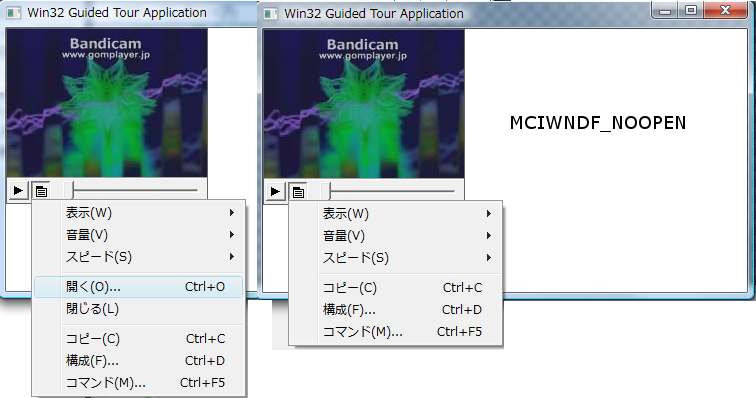


// GT_HelloWorldWin32.cpp
// compile with: /D_UNICODE /DUNICODE /DWIN32 /D_WINDOWS /c

#include <windows.h>
#include <stdlib.h>
#include <string.h>
#include <tchar.h>

#include <dshow.h>

// Global variables

// The main window class name.
static TCHAR szWindowClass[] = _T("win32app");

// The string that appears in the application's title bar.
static TCHAR szTitle[] = _T("Win32 Guided Tour Application");

HINSTANCE hInst;

// Forward declarations of functions included in this code module:
LRESULT CALLBACK WndProc(HWND, UINT, WPARAM, LPARAM);

int WINAPI WinMain(HINSTANCE hInstance,
 HINSTANCE hPrevInstance,
 LPSTR lpCmdLine,
 int nCmdShow)
{
 WNDCLASSEX wcex;

 wcex.cbSize = sizeof(WNDCLASSEX);
 wcex.style          = CS_HREDRAW | CS_VREDRAW;
 wcex.lpfnWndProc    = WndProc;
 wcex.cbClsExtra     = 0;
 wcex.cbWndExtra     = 0;
 wcex.hInstance      = hInstance;
 wcex.hIcon          = LoadIcon(hInstance, MAKEINTRESOURCE(IDI_APPLICATION));
 wcex.hCursor        = LoadCursor(NULL, IDC_ARROW);
 wcex.hbrBackground  = (HBRUSH)(COLOR_WINDOW+1);
 wcex.lpszMenuName   = NULL;
 wcex.lpszClassName  = szWindowClass;
 wcex.hIconSm        = LoadIcon(wcex.hInstance, MAKEINTRESOURCE(IDI_APPLICATION));

 if (!RegisterClassEx(&wcex))
 {
  MessageBox(NULL,
   _T("Call to RegisterClassEx failed!"),
   _T("Win32 Guided Tour"),
   NULL);

  return 1;
 }

 hInst = hInstance; // Store instance handle in our global variable

 // The parameters to CreateWindow explained:
 // szWindowClass: the name of the application
 // szTitle: the text that appears in the title bar
 // WS_OVERLAPPEDWINDOW: the type of window to create
 // CW_USEDEFAULT, CW_USEDEFAULT: initial position (x, y)
 // 500, 100: initial size (width, length)
 // NULL: the parent of this window
 // NULL: this application does not have a menu bar
 // hInstance: the first parameter from WinMain
 // NULL: not used in this application
 HWND hWnd = CreateWindow(
  szWindowClass,
  szTitle,
  WS_OVERLAPPEDWINDOW,
  CW_USEDEFAULT, CW_USEDEFAULT,
  500, 400,
  NULL,
  NULL,
  hInstance,
  NULL
  );

 if (!hWnd)
 {
  MessageBox(NULL,
   _T("Call to CreateWindow failed!"),
   _T("Win32 Guided Tour"),
   NULL);

  return 1;
 }

 // The parameters to ShowWindow explained:
 // hWnd: the value returned from CreateWindow
 // nCmdShow: the fourth parameter from WinMain
 ShowWindow(hWnd,
  nCmdShow);
 UpdateWindow(hWnd);

 // Main message loop:
 MSG msg;
 while (GetMessage(&msg, NULL, 0, 0))
 {
  TranslateMessage(&msg);
  DispatchMessage(&msg);
 }

 return (int) msg.wParam;
}

//
//  FUNCTION: WndProc(HWND, UINT, WPARAM, LPARAM)
//
//  PURPOSE:  Processes messages for the main window.
//
//  WM_PAINT    - Paint the main window
//  WM_DESTROY  - post a quit message and return
//
//
LRESULT CALLBACK WndProc(HWND hWnd, UINT message, WPARAM wParam, LPARAM lParam)
{
 PAINTSTRUCT ps;
 HDC hdc;
 TCHAR greeting[] = _T("Hello, World!");

 IGraphBuilder *pGraph = NULL;
 IMediaControl *pControl = NULL;
 IMediaEvent   *pEvent = NULL;
 IVideoWindow  *pVideoWindow = NULL;

 HRESULT hr = CoInitialize(NULL);// COM ライブラリを初期化する。

 switch (message)
 {
 case WM_CREATE://ウインドウ作成時の処理

  // フィルタ グラフ マネージャを作成し、インターフェイスを問い合わせる。
  hr = CoCreateInstance(CLSID_FilterGraph, NULL, CLSCTX_INPROC_SERVER,
   IID_IGraphBuilder, (void **)&pGraph);
  if (FAILED(hr))
  {
   printf("ERROR - Could not create the Filter Graph Manager.");

  }

  hr = pGraph->QueryInterface(IID_IMediaControl, (void **)&pControl);
  hr = pGraph->QueryInterface(IID_IMediaEvent, (void **)&pEvent);

  hr = pGraph->QueryInterface(IID_IVideoWindow, (LPVOID*)&pVideoWindow);

  // グラフを作成する。 重要 : この文字列をシステム上のファイルに置き換える。
  hr = pGraph->RenderFile(L"E:\\sampleMovie\\avi_divx5_mp3.avi", NULL);

  // 描画先ウィンドウの設定
  hr = pVideoWindow->put_Owner((OAHWND)hWnd);
  hr = pVideoWindow->put_WindowStyle(WS_CHILD|WS_CLIPSIBLINGS);
  hr = pVideoWindow->put_Visible(OATRUE);

  // グラフを実行する。
  hr = pControl->Run();

  // 描画先ウィンドウ内の描画位置の設定
  pVideoWindow->SetWindowPosition(0, 0, 320, 240);

  pVideoWindow->Release();
  pControl->Release();
  pEvent->Release();
  pGraph->Release();
  CoUninitialize();

  break;
 case WM_PAINT:
  hdc = BeginPaint(hWnd, &ps);

  // Here your application is laid out.
  // For this introduction, we just print out "Hello, World!"
  // in the top left corner.
  //TextOut(hdc,5, 5,greeting, _tcslen(greeting));
  // End application-specific layout section.

  EndPaint(hWnd, &ps);
  break;
 case WM_DESTROY:
  PostQuitMessage(0);
  break;
 default:
  return DefWindowProc(hWnd, message, wParam, lParam);
  break;
 }

 return 0;
}

// GT_HelloWorldWin32.cpp
// compile with: /D_UNICODE /DUNICODE /DWIN32 /D_WINDOWS /c

#include <windows.h>
#include <stdlib.h>
#include <string.h>
#include <tchar.h>

// Global variables

// The main window class name.
static TCHAR szWindowClass[] = _T("win32app");

// The string that appears in the application's title bar.
static TCHAR szTitle[] = _T("Win32 Guided Tour Application");

HINSTANCE hInst;

// Forward declarations of functions included in this code module:
LRESULT CALLBACK WndProc(HWND, UINT, WPARAM, LPARAM);

#define ID_BUTTON1 100
#define ID_EDIT 200

int WINAPI WinMain(HINSTANCE hInstance,
                   HINSTANCE hPrevInstance,
                   LPSTR lpCmdLine,
                   int nCmdShow)
{
    WNDCLASSEX wcex;

    wcex.cbSize = sizeof(WNDCLASSEX);
    wcex.style          = CS_HREDRAW | CS_VREDRAW;
    wcex.lpfnWndProc    = WndProc;
    wcex.cbClsExtra     = 0;
    wcex.cbWndExtra     = 0;
    wcex.hInstance      = hInstance;
    wcex.hIcon          = LoadIcon(hInstance, MAKEINTRESOURCE(IDI_APPLICATION));
    wcex.hCursor        = LoadCursor(NULL, IDC_ARROW);
    wcex.hbrBackground  = (HBRUSH)(COLOR_WINDOW+1);
    wcex.lpszMenuName   = NULL;
    wcex.lpszClassName  = szWindowClass;
    wcex.hIconSm        = LoadIcon(wcex.hInstance, MAKEINTRESOURCE(IDI_APPLICATION));

    if (!RegisterClassEx(&wcex))
    {
        MessageBox(NULL,
            _T("Call to RegisterClassEx failed!"),
            _T("Win32 Guided Tour"),
            NULL);

        return 1;
    }

    hInst = hInstance; // Store instance handle in our global variable

    // The parameters to CreateWindow explained:
    // szWindowClass: the name of the application
    // szTitle: the text that appears in the title bar
    // WS_OVERLAPPEDWINDOW: the type of window to create
    // CW_USEDEFAULT, CW_USEDEFAULT: initial position (x, y)
    // 500, 100: initial size (width, length)
    // NULL: the parent of this window
    // NULL: this application does not have a menu bar
    // hInstance: the first parameter from WinMain
    // NULL: not used in this application
    HWND hWnd = CreateWindow(
        szWindowClass,
        szTitle,
        WS_OVERLAPPEDWINDOW,
        CW_USEDEFAULT, CW_USEDEFAULT,
        500, 100,
        NULL,
        NULL,
        hInstance,
        NULL
    );

    if (!hWnd)
    {
        MessageBox(NULL,
            _T("Call to CreateWindow failed!"),
            _T("Win32 Guided Tour"),
            NULL);

        return 1;
    }

    // The parameters to ShowWindow explained:
    // hWnd: the value returned from CreateWindow
    // nCmdShow: the fourth parameter from WinMain
    ShowWindow(hWnd,
        nCmdShow);
    UpdateWindow(hWnd);

    // Main message loop:
    MSG msg;
    while (GetMessage(&msg, NULL, 0, 0))
    {
        TranslateMessage(&msg);
        DispatchMessage(&msg);
    }

    return (int) msg.wParam;
}

//
//  FUNCTION: WndProc(HWND, UINT, WPARAM, LPARAM)
//
//  PURPOSE:  Processes messages for the main window.
//
//  WM_PAINT    - Paint the main window
//  WM_DESTROY  - post a quit message and return
//
//
LRESULT CALLBACK WndProc(HWND hWnd, UINT message, WPARAM wParam, LPARAM lParam)
{
    PAINTSTRUCT ps;
 int    wmId, wmEvent, len;
    HDC hdc;
    TCHAR greeting[] = _T("Hello, World!");
 static HWND  hButton,hEdit;
 TCHAR *tchstr2 = TEXT("ボタンで追記。\r\n");

    switch (message)
    {
 case WM_CREATE://ウインドウ作成時の処理
  //ボタンの作成
  hButton = CreateWindowEx(0, TEXT("BUTTON"), TEXT("Button1"),
   WS_CHILD | WS_VISIBLE | BS_PUSHBUTTON,
   100, 0, 100, 30,
   hWnd,
   (HMENU)ID_BUTTON1,
   (HINSTANCE)GetWindowLong(hWnd, GWL_HINSTANCE),
   NULL);
  //エディットボックスの作成
  hEdit = CreateWindowEx(WS_EX_CLIENTEDGE, // 拡張ウィンドウスタイル
   TEXT("EDIT"),
   TEXT("ここに入力\r\n"),
   WS_CHILD | WS_VISIBLE | WS_HSCROLL |
   WS_VSCROLL | ES_LEFT | ES_MULTILINE |
   ES_AUTOHSCROLL | ES_AUTOVSCROLL ,
   0, 0,
   LOWORD(lParam), HIWORD(lParam),
   hWnd,
   (HMENU)ID_EDIT,
   hInst,
   NULL);

  SetFocus(hEdit);

  break;
 case WM_SIZE://ウインドウのサイズが変わったとき(ウインドウ初回生成時も)に実行
  MoveWindow(hEdit, 0, 30, LOWORD(lParam), HIWORD(lParam), TRUE);
  break;
    case WM_PAINT:
        hdc = BeginPaint(hWnd, &ps);

        // Here your application is laid out.
        // For this introduction, we just print out "Hello, World!"
        // in the top left corner.
        TextOut(hdc,
            5, 5,
            greeting, _tcslen(greeting));
        // End application-specific layout section.

        EndPaint(hWnd, &ps);
        break;
 case WM_COMMAND:
  wmId = LOWORD(wParam);
  wmEvent = HIWORD(wParam);
  switch (wmId)
  {
  case ID_BUTTON1://ボタンが押された時の処理
   len = GetWindowTextLength(GetDlgItem(hWnd, ID_EDIT));
   SendMessage(GetDlgItem(hWnd, ID_EDIT), EM_SETSEL, len, len);
   SendMessage(GetDlgItem(hWnd, ID_EDIT), EM_REPLACESEL, 0, (LPARAM)tchstr2);
   break;
  }

  break;

 case WM_DESTROY:
        PostQuitMessage(0);
        break;
    default:
        return DefWindowProc(hWnd, message, wParam, lParam);
        break;
    }

    return 0;
}

// GT_HelloWorldWin32.cpp
// compile with: /D_UNICODE /DUNICODE /DWIN32 /D_WINDOWS /c

#include <windows.h>
#include <stdlib.h>
#include <string.h>
#include <tchar.h>

// Global variables

// The main window class name.
static TCHAR szWindowClass[] = _T("win32app");

// The string that appears in the application's title bar.
static TCHAR szTitle[] = _T("Win32 Guided Tour Application");

HINSTANCE hInst;

// Forward declarations of functions included in this code module:
LRESULT CALLBACK WndProc(HWND, UINT, WPARAM, LPARAM);

#define ID_BUTTON1 100
#define ID_EDIT 200

int WINAPI WinMain(HINSTANCE hInstance,
                   HINSTANCE hPrevInstance,
                   LPSTR lpCmdLine,
                   int nCmdShow)
{
    WNDCLASSEX wcex;

    wcex.cbSize = sizeof(WNDCLASSEX);
    wcex.style          = CS_HREDRAW | CS_VREDRAW;
    wcex.lpfnWndProc    = WndProc;
    wcex.cbClsExtra     = 0;
    wcex.cbWndExtra     = 0;
    wcex.hInstance      = hInstance;
    wcex.hIcon          = LoadIcon(hInstance, MAKEINTRESOURCE(IDI_APPLICATION));
    wcex.hCursor        = LoadCursor(NULL, IDC_ARROW);
    wcex.hbrBackground  = (HBRUSH)(COLOR_WINDOW+1);
    wcex.lpszMenuName   = NULL;
    wcex.lpszClassName  = szWindowClass;
    wcex.hIconSm        = LoadIcon(wcex.hInstance, MAKEINTRESOURCE(IDI_APPLICATION));

    if (!RegisterClassEx(&wcex))
    {
        MessageBox(NULL,
            _T("Call to RegisterClassEx failed!"),
            _T("Win32 Guided Tour"),
            NULL);

        return 1;
    }

    hInst = hInstance; // Store instance handle in our global variable

    // The parameters to CreateWindow explained:
    // szWindowClass: the name of the application
    // szTitle: the text that appears in the title bar
    // WS_OVERLAPPEDWINDOW: the type of window to create
    // CW_USEDEFAULT, CW_USEDEFAULT: initial position (x, y)
    // 500, 100: initial size (width, length)
    // NULL: the parent of this window
    // NULL: this application does not have a menu bar
    // hInstance: the first parameter from WinMain
    // NULL: not used in this application
    HWND hWnd = CreateWindow(
        szWindowClass,
        szTitle,
        WS_OVERLAPPEDWINDOW,
        CW_USEDEFAULT, CW_USEDEFAULT,
        500, 100,
        NULL,
        NULL,
        hInstance,
        NULL
    );

    if (!hWnd)
    {
        MessageBox(NULL,
            _T("Call to CreateWindow failed!"),
            _T("Win32 Guided Tour"),
            NULL);

        return 1;
    }

    // The parameters to ShowWindow explained:
    // hWnd: the value returned from CreateWindow
    // nCmdShow: the fourth parameter from WinMain
    ShowWindow(hWnd,
        nCmdShow);
    UpdateWindow(hWnd);

    // Main message loop:
    MSG msg;
    while (GetMessage(&msg, NULL, 0, 0))
    {
        TranslateMessage(&msg);
        DispatchMessage(&msg);
    }

    return (int) msg.wParam;
}

//
//  FUNCTION: WndProc(HWND, UINT, WPARAM, LPARAM)
//
//  PURPOSE:  Processes messages for the main window.
//
//  WM_PAINT    - Paint the main window
//  WM_DESTROY  - post a quit message and return
//
//
LRESULT CALLBACK WndProc(HWND hWnd, UINT message, WPARAM wParam, LPARAM lParam)
{
    PAINTSTRUCT ps;
 int    wmId, wmEvent;
    HDC hdc;
    TCHAR greeting[] = _T("Hello, World!");
 static HWND  hButton,hEdit;

    switch (message)
    {
 case WM_CREATE://ウインドウ作成時の処理
  //ボタンの作成
  hButton = CreateWindowEx(0, TEXT("BUTTON"), TEXT("Button1"),
   WS_CHILD | WS_VISIBLE | BS_PUSHBUTTON,
   100, 0, 100, 30,
   hWnd,
   (HMENU)ID_BUTTON1,
   (HINSTANCE)GetWindowLong(hWnd, GWL_HINSTANCE),
   NULL);
  //エディットボックスの作成
  hEdit = CreateWindowEx(WS_EX_CLIENTEDGE, // 拡張ウィンドウスタイル
   TEXT("EDIT"),
   TEXT("ここに入力\r\n"),
   WS_CHILD | WS_VISIBLE | WS_HSCROLL |
   WS_VSCROLL | ES_LEFT | ES_MULTILINE |
   ES_AUTOHSCROLL | ES_AUTOVSCROLL ,
   0, 0,
   LOWORD(lParam), HIWORD(lParam),
   hWnd,
   (HMENU)ID_EDIT,
   hInst,
   NULL);

  SetFocus(hEdit);

  break;
 case WM_SIZE://ウインドウのサイズが変わったとき(ウインドウ初回生成時も)に実行
  MoveWindow(hEdit, 0, 30, LOWORD(lParam), HIWORD(lParam), TRUE);
  break;
    case WM_PAINT:
        hdc = BeginPaint(hWnd, &ps);

        // Here your application is laid out.
        // For this introduction, we just print out "Hello, World!"
        // in the top left corner.
        TextOut(hdc,
            5, 5,
            greeting, _tcslen(greeting));
        // End application-specific layout section.

        EndPaint(hWnd, &ps);
        break;
 case WM_COMMAND:
  wmId = LOWORD(wParam);
  wmEvent = HIWORD(wParam);
  switch (wmId)
  {
  case ID_BUTTON1://ボタンが押された時の処理

   MessageBox(0,0,0,0);
   break;
  }

  break;

 case WM_DESTROY:
        PostQuitMessage(0);
        break;
    default:
        return DefWindowProc(hWnd, message, wParam, lParam);
        break;
    }

    return 0;
}

// GT_HelloWorldWin32.cpp
// compile with: /D_UNICODE /DUNICODE /DWIN32 /D_WINDOWS /c

#include <windows.h>
#include <stdlib.h>
#include <string.h>
#include <tchar.h>

// Global variables

// The main window class name.
static TCHAR szWindowClass[] = _T("win32app");

// The string that appears in the application's title bar.
static TCHAR szTitle[] = _T("Win32 Guided Tour Application");

HINSTANCE hInst;

// Forward declarations of functions included in this code module:
LRESULT CALLBACK WndProc(HWND, UINT, WPARAM, LPARAM);

#define ID_BUTTON1 (0)

int WINAPI WinMain(HINSTANCE hInstance,
                   HINSTANCE hPrevInstance,
                   LPSTR lpCmdLine,
                   int nCmdShow)
{
    WNDCLASSEX wcex;

    wcex.cbSize = sizeof(WNDCLASSEX);
    wcex.style          = CS_HREDRAW | CS_VREDRAW;
    wcex.lpfnWndProc    = WndProc;
    wcex.cbClsExtra     = 0;
    wcex.cbWndExtra     = 0;
    wcex.hInstance      = hInstance;
    wcex.hIcon          = LoadIcon(hInstance, MAKEINTRESOURCE(IDI_APPLICATION));
    wcex.hCursor        = LoadCursor(NULL, IDC_ARROW);
    wcex.hbrBackground  = (HBRUSH)(COLOR_WINDOW+1);
    wcex.lpszMenuName   = NULL;
    wcex.lpszClassName  = szWindowClass;
    wcex.hIconSm        = LoadIcon(wcex.hInstance, MAKEINTRESOURCE(IDI_APPLICATION));

    if (!RegisterClassEx(&wcex))
    {
        MessageBox(NULL,
            _T("Call to RegisterClassEx failed!"),
            _T("Win32 Guided Tour"),
            NULL);

        return 1;
    }

    hInst = hInstance; // Store instance handle in our global variable

    // The parameters to CreateWindow explained:
    // szWindowClass: the name of the application
    // szTitle: the text that appears in the title bar
    // WS_OVERLAPPEDWINDOW: the type of window to create
    // CW_USEDEFAULT, CW_USEDEFAULT: initial position (x, y)
    // 500, 100: initial size (width, length)
    // NULL: the parent of this window
    // NULL: this application does not have a menu bar
    // hInstance: the first parameter from WinMain
    // NULL: not used in this application
    HWND hWnd = CreateWindow(
        szWindowClass,
        szTitle,
        WS_OVERLAPPEDWINDOW,
        CW_USEDEFAULT, CW_USEDEFAULT,
        500, 100,
        NULL,
        NULL,
        hInstance,
        NULL
    );

    if (!hWnd)
    {
        MessageBox(NULL,
            _T("Call to CreateWindow failed!"),
            _T("Win32 Guided Tour"),
            NULL);

        return 1;
    }

    // The parameters to ShowWindow explained:
    // hWnd: the value returned from CreateWindow
    // nCmdShow: the fourth parameter from WinMain
    ShowWindow(hWnd,
        nCmdShow);
    UpdateWindow(hWnd);

    // Main message loop:
    MSG msg;
    while (GetMessage(&msg, NULL, 0, 0))
    {
        TranslateMessage(&msg);
        DispatchMessage(&msg);
    }

    return (int) msg.wParam;
}

//
//  FUNCTION: WndProc(HWND, UINT, WPARAM, LPARAM)
//
//  PURPOSE:  Processes messages for the main window.
//
//  WM_PAINT    - Paint the main window
//  WM_DESTROY  - post a quit message and return
//
//
LRESULT CALLBACK WndProc(HWND hWnd, UINT message, WPARAM wParam, LPARAM lParam)
{
    PAINTSTRUCT ps;
 int    wmId, wmEvent;
    HDC hdc;
    TCHAR greeting[] = _T("Hello, World!");
 static HWND  hButton;

    switch (message)
    {
 case WM_CREATE://ウインドウ作成時の処理
  hButton = CreateWindowEx(0, TEXT("BUTTON"), TEXT("Button1"),
   WS_CHILD | WS_VISIBLE | BS_PUSHBUTTON,
   100, 0, 100, 30,
   hWnd,
   (HMENU)ID_BUTTON1,
   (HINSTANCE)GetWindowLong(hWnd, GWL_HINSTANCE),
   NULL);

  break;
    case WM_PAINT:
        hdc = BeginPaint(hWnd, &ps);

        // Here your application is laid out.
        // For this introduction, we just print out "Hello, World!"
        // in the top left corner.
        TextOut(hdc,
            5, 5,
            greeting, _tcslen(greeting));
        // End application-specific layout section.

        EndPaint(hWnd, &ps);
        break;
 case WM_COMMAND:
  wmId = LOWORD(wParam);
  wmEvent = HIWORD(wParam);
  switch (wmId)
  {
  case ID_BUTTON1://ボタンが押された時の処理

   MessageBox(0,0,0,0);
   break;
  }

  break;

 case WM_DESTROY:
        PostQuitMessage(0);
        break;
    default:
        return DefWindowProc(hWnd, message, wParam, lParam);
        break;
    }

    return 0;
}
#include "stdafx.h"

void f(){
 MessageBox(NULL, TEXT("ボタンがクリックされた"),
  TEXT("タイトル"),
  NULL);
}

//他の関数........
void f();

//他の関数........
#pragma once

#include <windows.h>
#include <stdlib.h>
#include <string.h>
#include <tchar.h>

#include "Resource.h"

#include "MyFunc.h"


// GT_HelloWorldWin32.cpp
// compile with: /D_UNICODE /DUNICODE /DWIN32 /D_WINDOWS /c

#include <windows.h>
#include <stdlib.h>
#include <string.h>
#include <tchar.h>
#include "resource.h"

// Global variables

// The main window class name.
static TCHAR szWindowClass[] = _T("win32app");

// The string that appears in the application's title bar.
static TCHAR szTitle[] = _T("Win32 Guided Tour Application");

HINSTANCE hInst;

// Forward declarations of functions included in this code module:
LRESULT CALLBACK WndProc(HWND, UINT, WPARAM, LPARAM);

int WINAPI WinMain(HINSTANCE hInstance,
 HINSTANCE hPrevInstance,
 LPSTR lpCmdLine,
 int nCmdShow)
{
 WNDCLASSEX wcex;

 wcex.cbSize = sizeof(WNDCLASSEX);
 wcex.style          = CS_HREDRAW | CS_VREDRAW;
 wcex.lpfnWndProc    = WndProc;
 wcex.cbClsExtra     = 0;
 wcex.cbWndExtra     = 0;
 wcex.hInstance      = hInstance;
 wcex.hIcon          = LoadIcon(hInstance, MAKEINTRESOURCE(IDI_APPLICATION));
 wcex.hCursor        = LoadCursor(NULL, IDC_ARROW);
 wcex.hbrBackground  = (HBRUSH)(COLOR_WINDOW+1);
 wcex.lpszMenuName   = MAKEINTRESOURCE(IDC_WIN32SANPLE);
 wcex.lpszClassName  = szWindowClass;
 wcex.hIconSm        = LoadIcon(wcex.hInstance, MAKEINTRESOURCE(IDI_APPLICATION));

 if (!RegisterClassEx(&wcex))
 {
  MessageBox(NULL,
   _T("Call to RegisterClassEx failed!"),
   _T("Win32 Guided Tour"),
   NULL);

  return 1;
 }

 hInst = hInstance; // Store instance handle in our global variable

 // The parameters to CreateWindow explained:
 // szWindowClass: the name of the application
 // szTitle: the text that appears in the title bar
 // WS_OVERLAPPEDWINDOW: the type of window to create
 // CW_USEDEFAULT, CW_USEDEFAULT: initial position (x, y)
 // 500, 100: initial size (width, length)
 // NULL: the parent of this window
 // NULL: this application does not have a menu bar
 // hInstance: the first parameter from WinMain
 // NULL: not used in this application
 HWND hWnd = CreateWindow(
  szWindowClass,
  szTitle,
  WS_OVERLAPPEDWINDOW,
  CW_USEDEFAULT, CW_USEDEFAULT,
  500, 100,
  NULL,
  NULL,
  hInstance,
  NULL
  );

 if (!hWnd)
 {
  MessageBox(NULL,
   _T("Call to CreateWindow failed!"),
   _T("Win32 Guided Tour"),
   NULL);

  return 1;
 }

 // The parameters to ShowWindow explained:
 // hWnd: the value returned from CreateWindow
 // nCmdShow: the fourth parameter from WinMain
 ShowWindow(hWnd,
  nCmdShow);
 UpdateWindow(hWnd);

 // Main message loop:
 MSG msg;
 while (GetMessage(&msg, NULL, 0, 0))
 {
  TranslateMessage(&msg);
  DispatchMessage(&msg);
 }

 return (int) msg.wParam;
}

//
//  FUNCTION: WndProc(HWND, UINT, WPARAM, LPARAM)
//
//  PURPOSE:  Processes messages for the main window.
//
//  WM_PAINT    - Paint the main window
//  WM_DESTROY  - post a quit message and return
//
//
LRESULT CALLBACK WndProc(HWND hWnd, UINT message, WPARAM wParam, LPARAM lParam)
{
 PAINTSTRUCT ps;
 HDC hdc;
 TCHAR greeting[] = _T("Hello, World!");
 static HMENU hMenu;
 int wmId, wmEvent;
 static HWND hButton;

 switch (message)
 {
 case WM_CREATE://ウインドウ作成時の処理
  hButton = CreateWindowEx(0, TEXT("BUTTON"), TEXT("Button1"),
   WS_CHILD | WS_VISIBLE | BS_PUSHBUTTON,
   100, 0, 100, 30,
   hWnd, (HMENU)ID_BUTTON,
   (HINSTANCE)GetWindowLong(hWnd, GWL_HINSTANCE), NULL);
  break;

 case WM_COMMAND:
  wmId = LOWORD(wParam);
  wmEvent = HIWORD(wParam);
  switch (wmId)
  {
  case ID_BUTTON://ボタンが押された時の処理
   MessageBox(NULL, TEXT("ボタンがクリックされた"),
    TEXT("タイトル"),
    NULL);
   break;
  case IDM_MAKE:
   MessageBox(NULL,TEXT("新規作成が選択された"),
    TEXT("タイトル"),
    NULL);
   break;
  case IDM_OPEN:
   MessageBox(NULL,TEXT("開くが選択された"),
    TEXT("タイトル"),
    NULL);
   break;
  case IDM_EXIT://プログラムの終了
   DestroyWindow(hWnd);
   break;
  default:
   return DefWindowProc(hWnd, message, wParam, lParam);
  }
  break;

 case WM_PAINT:
  hdc = BeginPaint(hWnd, &ps);

  // Here your application is laid out.
  // For this introduction, we just print out "Hello, World!"
  // in the top left corner.
  TextOut(hdc,
   5, 5,
   greeting, _tcslen(greeting));
  // End application-specific layout section.

  EndPaint(hWnd, &ps);
  break;
 case WM_DESTROY:
  PostQuitMessage(0);
  break;
 default:
  return DefWindowProc(hWnd, message, wParam, lParam);
  break;
 }

 return 0;
}

#define IDM_MAKE 100
#define IDM_OPEN 101
#define IDM_ABOUT 104
#define IDM_EXIT 105
#define IDC_WIN32SANPLE 109
最後の行は改行しないとエラーが出る。


#include "resource.h"

/////////////////////////////////////////////////////////////////////////////
//
// メニュー
//

IDC_WIN32SANPLE MENU
BEGIN
    POPUP "ファイル(&F)"
    BEGIN
    MENUITEM "新規作成(&N)" , IDM_MAKE
    MENUITEM "開く(&O)" , IDM_OPEN
    MENUITEM "アプリケーションの終了(&X)", IDM_EXIT
    END
    POPUP "ヘルプ(&H)"
    BEGIN
    MENUITEM "バージョン情報(&A)...", IDM_ABOUT
    END
END
// GT_HelloWorldWin32.cpp
// compile with: /D_UNICODE /DUNICODE /DWIN32 /D_WINDOWS /c

#include <windows.h>
#include <stdlib.h>
#include <string.h>
#include <tchar.h>
#include "resource.h"

// Global variables

// The main window class name.
static TCHAR szWindowClass[] = _T("win32app");

// The string that appears in the application's title bar.
static TCHAR szTitle[] = _T("Win32 Guided Tour Application");

HINSTANCE hInst;

// Forward declarations of functions included in this code module:
LRESULT CALLBACK WndProc(HWND, UINT, WPARAM, LPARAM);

int WINAPI WinMain(HINSTANCE hInstance,
 HINSTANCE hPrevInstance,
 LPSTR lpCmdLine,
 int nCmdShow)
{
 WNDCLASSEX wcex;

 wcex.cbSize = sizeof(WNDCLASSEX);
 wcex.style          = CS_HREDRAW | CS_VREDRAW;
 wcex.lpfnWndProc    = WndProc;
 wcex.cbClsExtra     = 0;
 wcex.cbWndExtra     = 0;
 wcex.hInstance      = hInstance;
 wcex.hIcon          = LoadIcon(hInstance, MAKEINTRESOURCE(IDI_APPLICATION));
 wcex.hCursor        = LoadCursor(NULL, IDC_ARROW);
 wcex.hbrBackground  = (HBRUSH)(COLOR_WINDOW+1);
 wcex.lpszMenuName   = MAKEINTRESOURCE(IDC_WIN32SANPLE);
 wcex.lpszClassName  = szWindowClass;
 wcex.hIconSm        = LoadIcon(wcex.hInstance, MAKEINTRESOURCE(IDI_APPLICATION));

 if (!RegisterClassEx(&wcex))
 {
  MessageBox(NULL,
   _T("Call to RegisterClassEx failed!"),
   _T("Win32 Guided Tour"),
   NULL);

  return 1;
 }

 hInst = hInstance; // Store instance handle in our global variable

 // The parameters to CreateWindow explained:
 // szWindowClass: the name of the application
 // szTitle: the text that appears in the title bar
 // WS_OVERLAPPEDWINDOW: the type of window to create
 // CW_USEDEFAULT, CW_USEDEFAULT: initial position (x, y)
 // 500, 100: initial size (width, length)
 // NULL: the parent of this window
 // NULL: this application does not have a menu bar
 // hInstance: the first parameter from WinMain
 // NULL: not used in this application
 HWND hWnd = CreateWindow(
  szWindowClass,
  szTitle,
  WS_OVERLAPPEDWINDOW,
  CW_USEDEFAULT, CW_USEDEFAULT,
  500, 100,
  NULL,
  NULL,
  hInstance,
  NULL
  );

 if (!hWnd)
 {
  MessageBox(NULL,
   _T("Call to CreateWindow failed!"),
   _T("Win32 Guided Tour"),
   NULL);

  return 1;
 }

 // The parameters to ShowWindow explained:
 // hWnd: the value returned from CreateWindow
 // nCmdShow: the fourth parameter from WinMain
 ShowWindow(hWnd,
  nCmdShow);
 UpdateWindow(hWnd);

 // Main message loop:
 MSG msg;
 while (GetMessage(&msg, NULL, 0, 0))
 {
  TranslateMessage(&msg);
  DispatchMessage(&msg);
 }

 return (int) msg.wParam;
}

//
//  FUNCTION: WndProc(HWND, UINT, WPARAM, LPARAM)
//
//  PURPOSE:  Processes messages for the main window.
//
//  WM_PAINT    - Paint the main window
//  WM_DESTROY  - post a quit message and return
//
//
LRESULT CALLBACK WndProc(HWND hWnd, UINT message, WPARAM wParam, LPARAM lParam)
{
 PAINTSTRUCT ps;
 HDC hdc;
 TCHAR greeting[] = _T("Hello, World!");
 static HMENU hMenu;
 int wmId, wmEvent;


 switch (message)
 {
 case WM_COMMAND:
  wmId = LOWORD(wParam);
  wmEvent = HIWORD(wParam);
  // 選択したメニューの処理
  switch (wmId)
  {
  case IDM_MAKE:
   MessageBox(NULL,TEXT("新規作成が選択された"),
    TEXT("タイトル"),
    NULL);
   break;
  case IDM_OPEN:
   MessageBox(NULL,TEXT("開くが選択された"),
    TEXT("タイトル"),
    NULL);
   break;
  case IDM_EXIT://プログラムの終了
   DestroyWindow(hWnd);
   break;
  default:
   return DefWindowProc(hWnd, message, wParam, lParam);
  }
  break;

 case WM_PAINT:
  hdc = BeginPaint(hWnd, &ps);

  // Here your application is laid out.
  // For this introduction, we just print out "Hello, World!"
  // in the top left corner.
  TextOut(hdc,
   5, 5,
   greeting, _tcslen(greeting));
  // End application-specific layout section.

  EndPaint(hWnd, &ps);
  break;
 case WM_DESTROY:
  PostQuitMessage(0);
  break;
 default:
  return DefWindowProc(hWnd, message, wParam, lParam);
  break;
 }

 return 0;
}

// GT_HelloWorldWin32.cpp
// compile with: /D_UNICODE /DUNICODE /DWIN32 /D_WINDOWS /c

#include <windows.h>
#include <stdlib.h>
#include <string.h>
#include <tchar.h>

// Global variables

// The main window class name.
static TCHAR szWindowClass[] = _T("win32app");

// The string that appears in the application's title bar.
static TCHAR szTitle[] = _T("Win32 Guided Tour Application");

HINSTANCE hInst;

// Forward declarations of functions included in this code module:
LRESULT CALLBACK WndProc(HWND, UINT, WPARAM, LPARAM);

int WINAPI WinMain(HINSTANCE hInstance,
                   HINSTANCE hPrevInstance,
                   LPSTR lpCmdLine,
                   int nCmdShow)
{
    WNDCLASSEX wcex;

    wcex.cbSize = sizeof(WNDCLASSEX);
    wcex.style          = CS_HREDRAW | CS_VREDRAW;
    wcex.lpfnWndProc    = WndProc;
    wcex.cbClsExtra     = 0;
    wcex.cbWndExtra     = 0;
    wcex.hInstance      = hInstance;
    wcex.hIcon          = LoadIcon(hInstance, MAKEINTRESOURCE(IDI_APPLICATION));
    wcex.hCursor        = LoadCursor(NULL, IDC_ARROW);
    wcex.hbrBackground  = (HBRUSH)(COLOR_WINDOW+1);
    wcex.lpszMenuName   = NULL;
    wcex.lpszClassName  = szWindowClass;
    wcex.hIconSm        = LoadIcon(wcex.hInstance, MAKEINTRESOURCE(IDI_APPLICATION));

    if (!RegisterClassEx(&wcex))
    {
        MessageBox(NULL,
            _T("Call to RegisterClassEx failed!"),
            _T("Win32 Guided Tour"),
            NULL);

        return 1;
    }

    hInst = hInstance; // Store instance handle in our global variable

    // The parameters to CreateWindow explained:
    // szWindowClass: the name of the application
    // szTitle: the text that appears in the title bar
    // WS_OVERLAPPEDWINDOW: the type of window to create
    // CW_USEDEFAULT, CW_USEDEFAULT: initial position (x, y)
    // 500, 100: initial size (width, length)
    // NULL: the parent of this window
    // NULL: this application does not have a menu bar
    // hInstance: the first parameter from WinMain
    // NULL: not used in this application
    HWND hWnd = CreateWindow(
        szWindowClass,
        szTitle,
        WS_OVERLAPPEDWINDOW,
        CW_USEDEFAULT, CW_USEDEFAULT,
        500, 100,
        NULL,
        NULL,
        hInstance,
        NULL
    );

    if (!hWnd)
    {
        MessageBox(NULL,
            _T("Call to CreateWindow failed!"),
            _T("Win32 Guided Tour"),
            NULL);

        return 1;
    }

    // The parameters to ShowWindow explained:
    // hWnd: the value returned from CreateWindow
    // nCmdShow: the fourth parameter from WinMain
    ShowWindow(hWnd,
        nCmdShow);
    UpdateWindow(hWnd);

    // Main message loop:
    MSG msg;
    while (GetMessage(&msg, NULL, 0, 0))
    {
        TranslateMessage(&msg);
        DispatchMessage(&msg);
    }

    return (int) msg.wParam;
}

//
//  FUNCTION: WndProc(HWND, UINT, WPARAM, LPARAM)
//
//  PURPOSE:  Processes messages for the main window.
//
//  WM_PAINT    - Paint the main window
//  WM_DESTROY  - post a quit message and return
//
//
LRESULT CALLBACK WndProc(HWND hWnd, UINT message, WPARAM wParam, LPARAM lParam)
{
    PAINTSTRUCT ps;
    HDC hdc;
    TCHAR greeting[] = _T("Hello, World!");

    switch (message)
    {
    case WM_PAINT:
        hdc = BeginPaint(hWnd, &ps);

        // Here your application is laid out.
        // For this introduction, we just print out "Hello, World!"
        // in the top left corner.
        TextOut(hdc,
            5, 5,
            greeting, _tcslen(greeting));
        // End application-specific layout section.

        EndPaint(hWnd, &ps);
        break;
    case WM_DESTROY:
        PostQuitMessage(0);
        break;
    default:
        return DefWindowProc(hWnd, message, wParam, lParam);
        break;
    }

    return 0;
}
#include <windows.h>

int WINAPI WinMain(
 HINSTANCE hInstance,
 HINSTANCE hPrevInstance,
 LPSTR lpCmdLine,
 int nCmdShow)
{
 MessageBox(0 , 0 ,0, 0);

 return 0;
}


